


Eucalyptus Three-Layer Boards: Understanding KKK vs. DKD
Jan 24, 2025
What Are Eucalyptus Three-Layer Boards?

Eucalyptus three-layer boards are boards composed of three layers of eucalyptus wood. Eucalyptus is a fast-growing species with moderate hardness and good strength, making it widely used in furniture manufacturing, interior decoration, wooden doors, and flooring substrates.
When producing these boards, different requirements may dictate various ways of joining the face and core layers (e.g., "finger-joint" vs. solid boards), resulting in varying qualities and applications.
The Difference Between KKK and DKD

KKK: All Three Layers Are Finger-Jointed
Key Features of KKK:
- All three layers are finger-jointed: The face, core, and back layers all use finger-joint technology.
- Excellent stability: Finger-jointing disperses imperfections such as knots and inconsistencies in wood grain, enhancing overall resistance to bending and cracking.
- Relatively higher cost: Full finger-jointing demands higher-quality raw materials and more precise processing, making it more complex and expensive to produce.
DKD: The Face and Back Are Not Finger-Jointed, While the Core Is Finger-Jointed
Key Features of DKD:
- Solid face and back layers: The face and back are one continuous board, offering a more uniform, aesthetically pleasing grain pattern.
- Finger-jointed core: The core layer is finger-jointed, providing a certain level of stability and resistance to deformation.
- Relatively lower cost: Only the core layer is finger-jointed, reducing some manufacturing complexity and generally resulting in a lower price than fully finger-jointed boards.
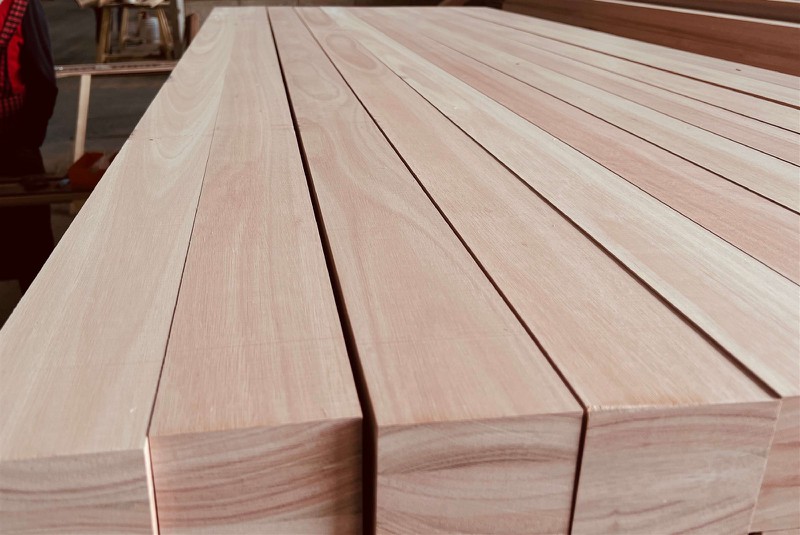
Advantages and Applications of Finger-Jointing
1. Improves Material Utilization
Finger-jointing makes it possible to join smaller offcuts or leftover pieces into larger usable boards, maximizing the use of wood resources.
2. Enhances Stability
Compared to a solid board, finger-jointed boards have interlocking grain patterns that help reduce deformation and cracking.
3. Environmentally Friendly
By reducing wood waste, finger-jointing supports sustainable resource use and helps preserve forests.
4. Wide Range of Uses
Finger-joint techniques are used for various wood species such as pine, oak, beech, and more, not just eucalyptus.
How to Choose
Based on Application and Budget
- If you need higher strength and stability and are less price-sensitive, choose KKK (all layers finger-jointed).
- If you want a balance of aesthetics and cost-effectiveness, DKD (solid face and back with a finger-jointed core) is a good option.
Examine the Surface and Details
- With KKK, you'll see visible finger-joint lines in all three layers.
- With DKD, the face and back appear as solid wood (no visible finger-joints), while only the internal core is finger-jointed.
Pay Attention to Environmental Standards and Glue Quality
- Regardless of the grade, check the glue's formaldehyde emission levels (e.g., E0, E1, E2) for indoor air quality and health considerations.
Balance Cost and Quality
- While KKK boards typically cost more due to increased manufacturing complexity and material selection, they may save on long-term maintenance if prolonged stability is essential.
-
DKD is more cost-effective and provides an attractive, solid-wood look on both surfaces, making it a popular choice for many residential and light commercial projects.
- KKK (all finger-jointed): More noticeable joint lines, superior strength, and better resistance to warping-ideal for higher structural requirements.
- DKD (solid face and back, finger-jointed core): A more seamless appearance on the outside, solid overall performance, and generally more budget-friendly.
Our address
Xiamen Reshine Wood Industry Co.,LTD
Unit 1908, No. 170 Tapu East Road,
Siming District, Xiamen City, Fujian Province, China
Phone Number
+86-592 506 0340
sales5@reshinewood.com


