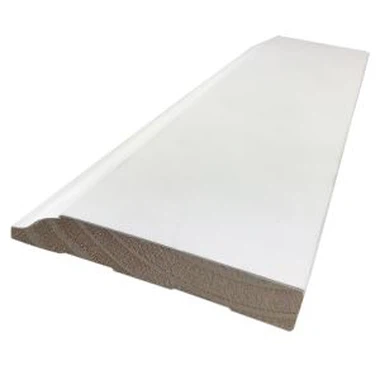
MDF mouldings
Aug 16, 2019
Medium-density fibreboard (MDF) is an engineered wood product made by breaking down hardwood or softwood residuals into wood fibres, often in a defibrator, combining it with wax and a resin binder, and forming panels by applying high temperature and pressure. MDF is generally denser than plywood. It is made up of separated fibres, but can be used as a building material similar in application to plywood. It is stronger and much denser than particle board.
The name derives from the distinction in densities of fibreboard. Large-scale production of MDF began in the 1980s, in both North America and Europe
Over time, the term MDF has become a generic name for any dry process fibre board. MDF is typically made up of 82% wood fibre, 9% urea-formaldehyde resin glue, 8% water and 1% paraffin wax. and the density is typically between 500 kg/m3 (31 lb/ft3) and 1,000 kg/m3 (62 lb/ft3). The range of density and classification as light, standard, or high density board is a misnomer and confusing. The density of the board, when evaluated in relation to the density of the fibre that goes into making the panel, is important. A thick MDF panel at a density of 700–720 kg/m3 may be considered as high density in the case of softwood fibre panels, whereas a panel of the same density made of hard wood fibres is not regarded as so. The evolution of the various types of MDF has been driven by differing need for specific applications.