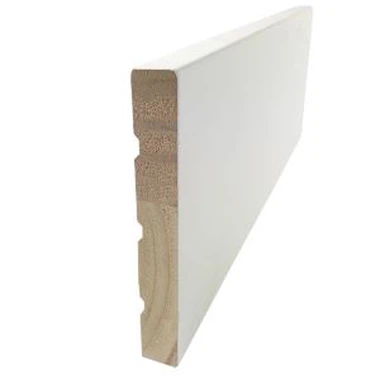
What Is Base Shoe Molding
Jun 18, 2020
In older houses, sagging beams are common, and even in newer installations, it can be difficult to get the floor perfectly flat and smooth.
Curved skirtings are usually a better solution than patchy skirtings, which are unsightly and waste energy-wasting draughts but still not the most elegant solution. Baseboards are very often provided with an additional thin piece of mold, a so-called quarter-round shoe mold, in order to close the gap between the underside of the baseboard and the floor. Installation of the base plates is completed by covering a gap in the bottoms of both baseplates with small molded parts. In the case of base shoe shapes, they are processed in such a way that the joints between the base plate and the floor are covered with a small piece, the "molding."
There are two types of shapes that can be used, one for the basic shape of the shoe and the other for the base plate itself.
In some situations, they can be used interchangeably, but each also has its own specific benefits. The corners of the basic shape can also be cut and coped with so that the two parts can collide more easily. While it is often more effective to buy a prefabricated base shoe, it is difficult for most newcomers to cope with the cladding at the right angle.
Genuine basic shoe shapes are available in three different sizes: quarter, quarter - round and true base. You may be able to find square moldings of different sizes, but a standard quarter and round moldings are often used for base shoes, while real basic molds are a quarter-round shape, typically 3 / 4 "by 3.4" in radius and profile. Genuine Base - Shoe shapes come in a variety of sizes, from 1 / 8 "to 2 / 3" and are typically lying on the floor.
They are bulky, but the positive is the flexibility that makes them useful for working on wavy floors. If you choose shoe shape, you should nail it to the baseboard, not the floor, when installing it. There is no need to cover large gaps between the floor and skirting boards, and there is a good chance that you will nail the shoe shape to a floor plate and not to your floor.
As a result, the floor can expand and contract freely without additional stress due to molding. The problem is that most floor coverings take up a little space around the edges to expand and shrink.
By not leaving a vertical gap, the wood is warped as it expands and shrinks when the pieces press against each other.
If you leave the base shape in place and lay a new floor, you can leave a gap between the existing base shape and the new floors. The reduced bulge gives the fairing a refined look, offers a little more ground clearance, and seems to "embrace" your baseboard. If you cover the lower part with a new floor covering: The basic shape shrinks so much that even more is covered by a quarter round.
The cutting begins with long round dowels, which are then cut and milled into their respective shape. Quarter-round shoe shapes are the most common form of basic shapes in the United States.
This type of molds is often stored in shops as they are very long. The basic shoes are usually made of wood, although some panel composite products are also available. The more complicated and complex the basic shapes are, the more they can be made of wood.
Many professionals prefer the basic shape because it looks more elegant and rectangular. For an elegant and modern look, some buyers can choose moldings made of aluminum or other forms of metal.
The basic shape of the shoes is smooth and has a wide vertical surface that makes nailing easy, but the lack of a flat nail surface can be a big problem for installers. If you do not use a pneumatic finishing nail, the molded parts may be more susceptible to crevices and dents. In addition to the elegance mentioned above, there are a number of other reasons why shoe shapes are the most popular standard choice for contractors.
Here at BHH, the profile of the shoe shape is embedded with a quarter-round shoe base and the other half with an oval or round base.
The shelf form consists of straight pieces of wood, MDF, or polystyrene, and the two curved walls look beautiful. Another feature that makes the entrance special is the curved wall on both sides.
The front of the base shoe is slightly more square and does not follow the radius of a circle like a quarter round. Base shoes also have a 90-degree angle on the back, but they are not flexible enough to round the curve without breaking.